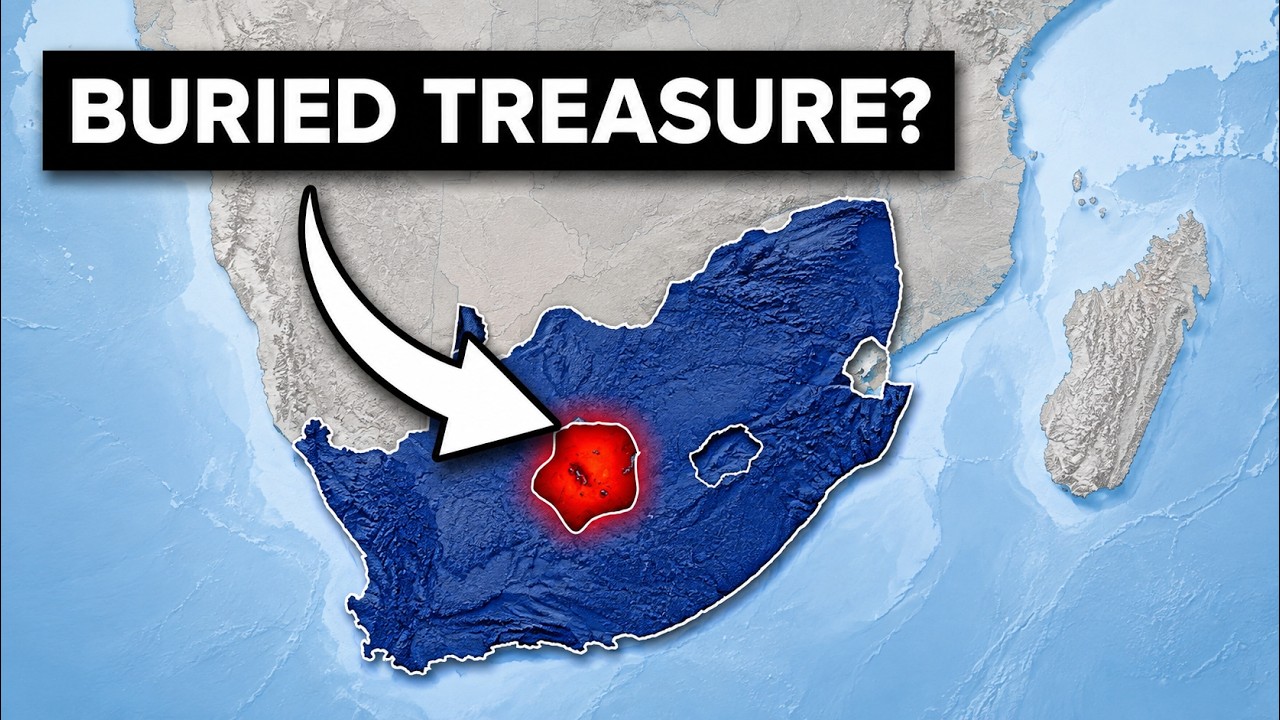
Why South Africa Is Sitting On The Most Valuable Land In Human History
Forget the safari.
Forget the wine farms.
Forget the postcard version of South Africa.
Underneath the country is something far more extraordinary: some of the oldest surviving continental crust on Earth — and an almost unbelievable concentration of gold, platinum, chromium, manganese, diamonds, uranium, fossils, and other resources.
South Africa isn’t sitting on valuable land because of luck.
It’s sitting on it because of 3.5 billion years of geological history.
In this video, we’re going deep into 25 facts that explain why South Africa may be sitting on some of the most valuable ground in human history.
You’ll discover the Kaapvaal Craton, ancient crust that survived for billions of years; the Makhonjwa Mountains, some of the oldest well-preserved rocks on Earth; and the Witwatersrand Basin, which produced an extraordinary share of all the gold ever mined by humans.
Then things get even crazier.
We’ll explore the Kalahari Manganese Field, the enormous Vredefort impact structure, the Bushveld Igneous Complex, South Africa’s diamond-bearing kimberlite pipes, and the Cullinan Diamond — the largest gem-quality diamond ever found.
But South Africa’s geological story isn’t just about valuable minerals.
The same ancient landscape preserves some of the world’s most important evidence about Earth’s early history and human evolution.
The Karoo contains an extraordinary fossil record from the Permian extinction. The Cradle of Humankind has produced some of the most important hominin fossils ever discovered. And the Taung Child helped transform the scientific understanding of humanity’s African origins.
And then there is Johannesburg.
One of the world’s great cities exists where it does largely because of a geological formation containing enormous gold deposits. That same mining industry helped shape South Africa’s economy, urban development, labor system, and political history.
We’ll also go beneath the surface — literally.
At some of the world’s deepest mines, workers descend roughly four kilometres underground into extreme heat and pressure. Scientists have even discovered microbial life living kilometres beneath the surface, powered by chemistry associated with radioactive decay rather than sunlight.
And the consequences of extracting all that wealth haven’t disappeared.
Billions of tonnes of mine tailings remain around Johannesburg. Groundwater has risen into abandoned mine workings, creating acid mine drainage. Mining-induced seismicity and sinkholes are additional reminders that the landscape has been permanently altered.
The deeper you go, the stranger the story becomes.
Because South Africa isn’t simply a country with valuable resources.
The country itself is the product of an almost impossible geological sequence that has been accumulating for billions of years.
Chapters
00:00 — South Africa’s Most Valuable Secret
00:53 — #25 The Kaapvaal Craton
01:32 — #24 The Makhonjwa Mountains
02:10 — #23 The Witwatersrand Gold Basin
02:51 — #22 Gold From Before Oxygen
03:40 — #21 The Kalahari Manganese Field
04:22 — #20 The Vredefort Impact
05:08 — #19 The Bushveld Platinum Complex
05:51 — #18 Chromium & Vanadium
06:26 — #17 Kimberlite & South Africa’s Diamonds
07:09 — #16 Diamonds Older Than Life
07:46 — #15 The Cullinan Diamond
08:24 — #14 South Africa & Gondwana
09:00 — #13 The Karoo Fossil Record
09:43 — #12 The Cradle of Humankind
10:24 — #11 The Taung Child
11:13 — #10 Johannesburg Exists Because of Gold
12:02 — #9 How Mining Shaped Apartheid
12:51 — #8 The South African War & Gold
13:40 — #7 The Deepest Workplace on Earth
14:18 — #6 Life Deep Underground
15:48 — #5 South Africa’s Nuclear Weapons
16:28 — #4 Billions of Tons of Mine Waste
17:07 — #3 Acid Mine Drainage
17:50 — #2 Mining-Induced Earthquakes & Sinkholes
18:29 — #1 The Geological Accident Behind Everything
19:57 — The Real Value of South Africa
If you enjoy South Africa geography, African geography, geology, natural resources, ancient history, human evolution, mining history, gold, diamonds, platinum, and hidden facts about countries, subscribe for more.
Which fact surprised you the most?
#SouthAfrica #Geography #Geology








Great explanation but worst AI image ever, nothing to do with the story
Hidden from people living in Johannesburg is the knowledge that the city is highly radioactive. Built over a uranium field. Thousands of tons of the stuff is brought to the surface by mining and dumped in open-air heaps. Wind blows this radioactive dust everywhere. The government won’t tell you this, but cancer is very prevalent in Johannesburg, mostly Thyroid and Breast.
Can I suggest that you scrutinise the historians providing your information because as the the saying goes, history is written by the victors. The reality is that most of southern Africa was largely uninhabited. The people living there were Koi/San but the ANC would have you believe that peoples referred to as Bantu ( Zulu and other tribes) were the orginal inhabitants. The statistics regarding the Apartheid of these peoples suggests that they were settled across the land. The fact is that the African populations followed the European expansion into the continent in search of work. The true story of South Africa has never actually been told and has been rewritten by both the Nationalist and ANC governments to suit their agendas.
Shhhhhhh, don’t let the cANCer party see this. Tell the world that we’re starving; there’s nothing to see here.
When I was at college, starting 1974 had a friend in the same year with me whose father was the engineering manager at Vaal Reefs In North West Province. I went to their home for a weekend and got to go down a mine shaft in a lift with my friend and some miners deep down in the earth. It was very exciting for me and enjoyed the experience but would hate to have had to work there for hours on end like the mine workers had to.
Gauteng(pronounce the G like an H. Anyway, my hometown has a meteorite site. Called Tswaing. Meaning “where the salt is”. Place has a weird/different ecosystem to its surroundings.
Check out an area called Kaapschehoop in the eastern Transvaal and let me know where you think the water came from to erode those massive boulders because from what i could see when i was there it was the highest point around with nothing in my mind that could do the job also the only place in SA where you will still find wild horses
As someone born there, I can tell you that Johannesburg has one of the largest man-made forests on earth. Most of the greenery was planted by the people living there. It has one of the most temperate climates on earth. If you want a balance in weather, you will not beat Joburg easily. The people who helped to mine JHB came from China and India as indentured workers. Many never went back and settled there to help form the backbone of the economy. There are 3 waves of settlars from China. (1) The original miners who were brought there when the mining boom started, (2) the early 1990’s saw a rush from Hong Kong of those who fled Hong Kong (and Taiwan) because they refused to be slaves of China and the CCP (3) the R5 store and other cheap trinket shops with their cheap and poorly made goods from Red China. They are the ones who are still intimately linked to China and help to establish Chinas economic chokehold on Africa.
The indians came with the first wave of Chinese, and were also employed as human labour in the mines to carry gold ore, but also cola from Mpumalanga’s massive coal reserves.
Many more miners came from the neighbouring African countries like Zimbabwe, Mozambique, Botswana, Zambia and Malawi. Southern Africa is a major economic force because of South Africa. Also on the cards is the major role that food production plays in South Africa, which is one of the most developed in the world, especially due to the Afrikaners, both White and Coloured, but more and more, Black farmers are taking part in the agriculture. The White farmers are an indispensable part of food security in South Africa and Southern Africa as a whole.
The national and provincial road networks in South Africa cam with ease compete with the best in the world, and is a major reason for South Africa’s economic prosperity, but the local roads have lately fallen into a poor state due to the corruption of the post-Apartheid government, and their gross incompetence.
Many things in South Africa are world-class, but people have to come and see it for themselves.
El valor geológico y mineral del sur de africa es simplemente impresionante.