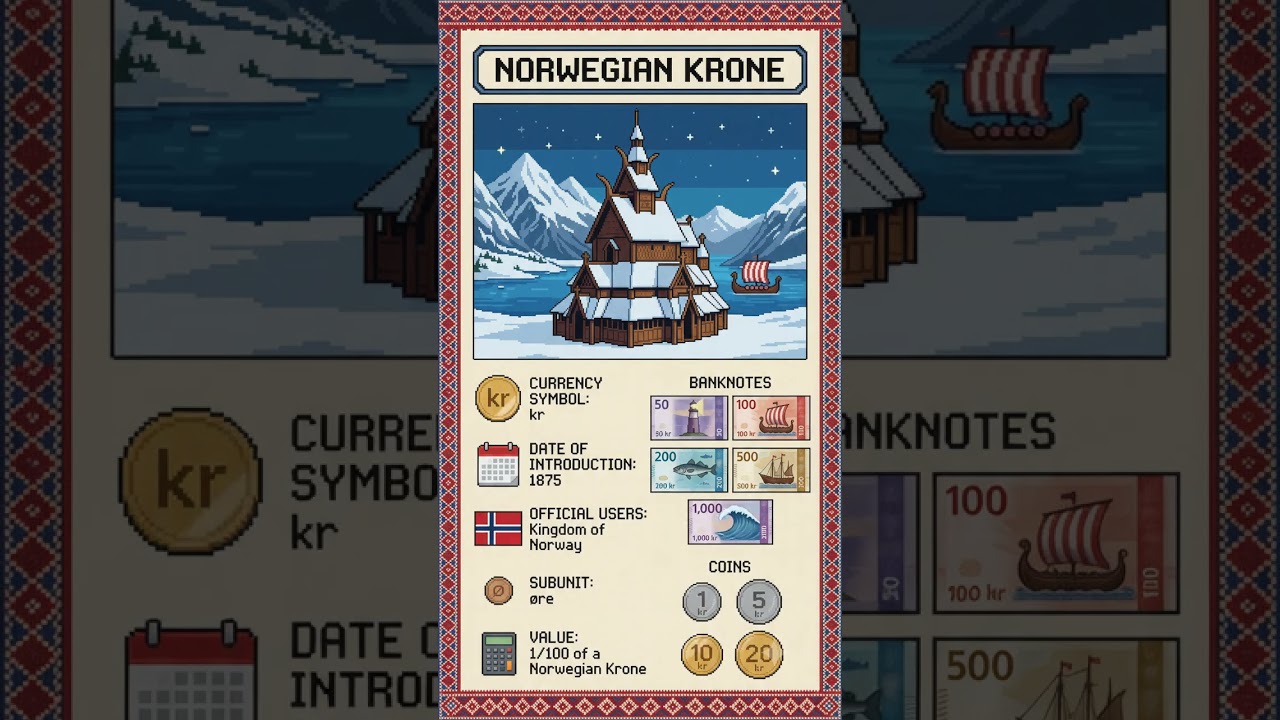
The Norwegian Krone (plural: kroner) is much more than just a means of transaction; it is a fascinating reflection of Norway’s history, culture, and deep connection to the sea. Represented by the sign kr and the ISO code NOK, this currency tells a unique story about a nation that transitioned from historical Viking roots to becoming one of the modern world’s wealthiest and most design-forward economies.
If you want to understand what makes the Norwegian currency so unique, here is an in-depth look at its main features, history, and surprising trivia.
🏛️ The History and Origins: From the Scandinavian Monetary Union
Before the krone, Norway utilized the speciedaler. However, in 1875, Norway introduced the krone when it joined the Scandinavian Monetary Union, alongside Sweden and Denmark.
The word krone literally translates to “crown.” This union was a massive success for regional trade, as all three countries pegged their currencies to gold at a par value. While the monetary union dissolved around the outbreak of World War I, Norway, Denmark, and Sweden all decided to keep “krone” (or krona in Swedish) as the name for their separate, independent currencies.
🎨 The “Most Beautiful Banknotes in the World”
In recent years, the Norwegian Krone gained global viral fame not for its economic strength, but for its stunning visual design. In 2014, Norges Bank (the central bank of Norway) held a competition to completely redesign the country’s banknotes. The result, fully launched in 2019, was widely dubbed by art and design critics as “the most beautiful money in the world.”
Breaking away from the traditional practice of printing portraits of famous historical figures (like politicians, scientists, or writers), Norway chose a central theme: The Sea.
The Obverse (Front): Features realistic maritime motifs, such as a traditional Viking longship on the 100 krone note, a lighthouse on the 50 krone note, and a codfish on the 200 krone note.
The Reverse (Back): Designed by the studio Snøhetta, the back features abstract, pixelated designs that represent the Beaufort wind scale. The more abstract and stretched the pixels, the stronger the wind represented on that specific note. It is a brilliant blend of modern art, data, and national identity.
🪙 Coins, Holes, and Subunits
The Norwegian krone is divided into smaller subunits called øre. While there used to be several øre coins in circulation, inflation eventually made them obsolete. Today, the 50 øre coin is no longer valid, meaning there are no physical øre coins left in circulation. Prices are electronically calculated in øre, but cash purchases are rounded to the nearest krone.
Currently, Norway issues coins in denominations of 1, 5, 10, and 20 kroner. If you look closely at the 1 krone and 5 kroner coins, you will notice a highly distinctive feature: they have a hole in the middle.
This design choice is not just aesthetic; it serves a highly practical purpose. Originally, the holes helped visually impaired people easily distinguish between different coin values by touch alone. It also allowed people to string their coins together for safekeeping before modern wallets became popular.
💳 A Future Without Cash?
Perhaps the most incredible fact about the Norwegian krone is that you might never actually see it if you visit Norway. The country is rapidly moving toward becoming the world’s first completely cashless society.
Norges Bank reports that less than 3% to 4% of all transactions in Norway are made using physical cash. From buying a cup of coffee to paying for a public restroom or buying fresh berries from a roadside stand, absolutely everything is paid for using mobile payment apps (like Vipps) or contactless credit and debit cards. In fact, many shops and restaurants in Oslo explicitly display signs reading “No Cash Accepted.”
Despite this digital shift, the physical Norwegian krone remains a masterpiece of history and modern design, standing tall as a proud symbol of Norway’s rich maritime heritage.
#norway , #currency , #pixelart , #history #numismatics, #coins, #money, #curiosities, #8bit, #banknotes








コメントを残す